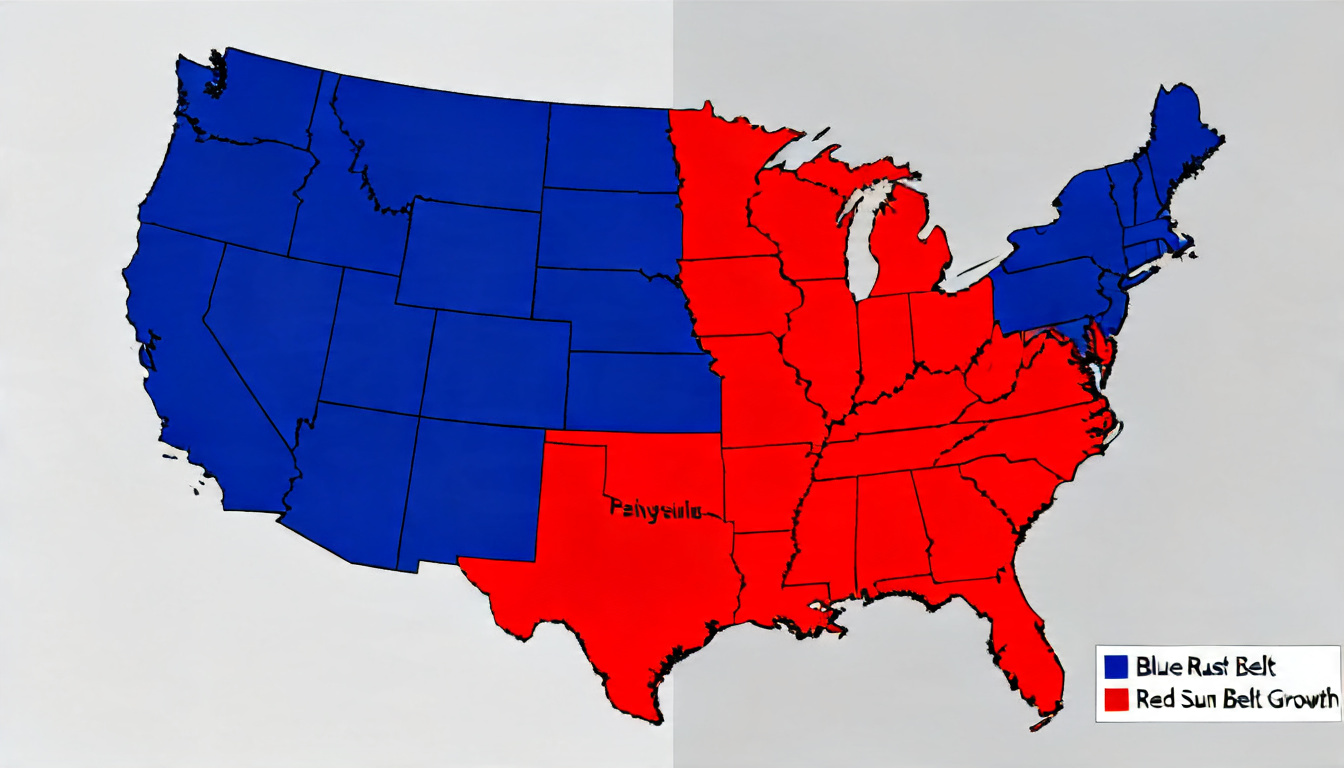
Almost every significant campaign war room in America has a map on the wall, and it looks different now than it did ten years ago. It hasn’t changed drastically or overnight, but it has changed enough for those who make a profession from winning elections to start discussing it in ways they never did before. Some people are concerned. To be honest, others are secretly ecstatic. Everyone seems to agree that things are changing and that what was effective in the past might not be so in the future.
The 2024 election marked the culmination of a gradual shift that had been taking place for decades: Republican dominance now extended far into suburbs and rural areas that had not previously leaned so strongly either way, while Democratic strength was once concentrated in the industrial North’s blue-collar factory towns.
That’s not a one-cycle tale or a blip. Political strategists on both sides are seeing this fundamental shift in the same way geologists observe a fault line: they are aware that a significant event is imminent but unsure of its precise timing.
Even if the political ramifications are anything but clear-cut, the statistics behind this are rather simple. Population decreases in historically Republican-led states, while population increases in Republican-led states like Texas and Florida have improved their positions in Congress and the Electoral College, diminishing the political influence of Democratic strongholds like California and New York. That’s how reapportionment works: it’s brutally significant, dry, and census-driven. The math is reset every 10 years. Additionally, it’s now resetting in ways that are concerning to one side and encouraging to the other.
| Topic | The Shifting U.S. Electoral Map & Party Strategy |
|---|---|
| Key Regions | Sun Belt (Texas, Florida, Georgia, Arizona), Rust Belt (Michigan, Pennsylvania, Wisconsin) |
| Key Event | 2024 Presidential Election & 2030 Census Projection |
| Primary Political Bodies | Republican National Committee (RNC), Democratic National Committee (DNC) |
| Central Issue | Population shifts realigning Electoral College votes toward the South and West |
| Next Critical Election | 2026 U.S. Midterms |
| Long-term Inflexion Point | 2030 Census & Reapportionment |
| Reference Links | Brennan Centre for Justice – Voting Maps After Next Census / Cook Political Report – Demographic Swingometer |
The situation quickly becomes clearer as you go through the data presented by the Brennan Centre’s analysts. By 2032, a Democratic candidate for president might win every state Kamala Harris won in 2024, including the battleground states of Michigan, Pennsylvania, and Wisconsin, known as the “Blue Wall,” yet still only win the Electoral College by a slim margin of 276-262. There would be very little opportunity for mistakes with that margin. The calculation breaks down when one state makes a mistake, and one turnout model performs poorly. Democrats may not have realised how unstable that corridor has become.
Republicans can win the White House without winning a single Rust Belt state, but Democrats would need to win in both the Sun Belt and the Rust Belt simultaneously. This disparity is glaring. That is a structural disadvantage rather than a strategic nuisance. And if someone starts early enough, it’s the type of issue that requires years of planning and expense to fix.
Following the release of population projections in January 2026, former DNC vice chair David Hogg made it clear that the party might not have a realistic chance of winning the White House in the 2030s if infrastructure were not built in the South. The fact that a well-known Democrat made such a statement in public, rather than at a private briefing, implies that the party’s customary optimism is giving way to real anxiety. It’s difficult to ignore the fact that candid confessions typically occur after elections rather than before.

On the Republican side, the focus is on longevity and consolidation rather than panic. The party’s current priorities, according to RNC Chair Michael Whatley, are twofold: strengthening the administration’s message on public safety, border security, and the economy, while also developing grassroots and digital infrastructure that can quickly adapt as electoral conditions shift. It is acknowledged that forming coalitions is a delicate process and that the events of 2024 should be reaffirmed rather than taken for granted. If a victorious coalition is neglected, it may quietly fall apart between elections.
Democrats were somewhat reassured by the 2025 off-year elections, as voters of colour and young people turned back to the party in ways that signalled 2024 may have been a transitory rather than a permanent realignment. There is some validity to that argument, and Democrats who support it are not incorrect to bring it up. However, if the underlying geography continues to change, short-term changes may have long-term effects. The electoral map won’t, but the voters might.
Given that the 2030 census would trigger another round of redistricting that could alter contested districts for 10 years, political strategists are already researching key House races and battleground states for 2026 and 2028. Though it never makes headlines, that type of long-term thinking is where true political power is developed and safeguarded. News cycle-winning campaigns are frequently not the ones subtly sketching lines that will be significant for a decade.
As all of this is happening, it seems like both sides are simultaneously playing two distinct games, one for the upcoming cycle and one for the upcoming age. Before Democrats have the infrastructure to compete in the Sun Belt, Republicans are attempting to seal the gains.
Democrats are attempting to maintain their position in the Rust Belt while determining whether a route through Georgia, Arizona, and ultimately Texas is feasible. Whether each tactic, when used flawlessly, is sufficient is still up for debate. No one has complete control over the map, and it continues to move.