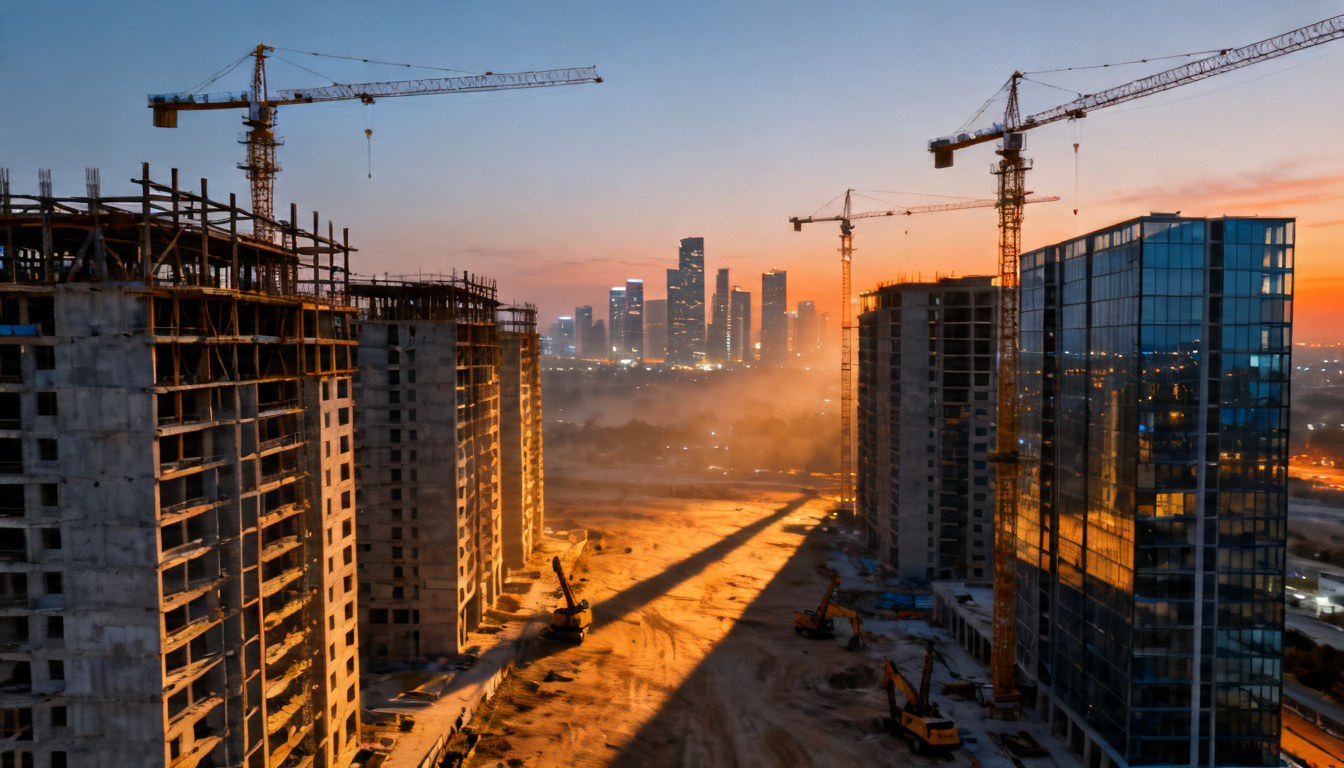
There is a form of economic expansion that looks wonderful on camera. Construction cranes dotted the horizon like mechanical birds, gleaming buildings catching the afternoon sun, and new roadways winding through what were once peaceful residential neighbourhoods or countryside. That version is adored by politicians. Developers of real estate also do. Campaign brochures and yearly investor presentations utilise this version.
Then there’s the version you see on a Tuesday at seven in the morning, when a teacher is trapped in traffic for two hours in an attempt to go to a job that no longer pays enough to cover her rent. It’s more difficult to take pictures of that version.
Rapid regional expansion, such as that driven by infrastructure investment, tech corridors, or proximity to a developing metropolis, has been almost universally praised without sufficient analysis. Cities praised as examples of economic dynamism include Hyderabad, Austin, and Nairobi.
Furthermore, the figures are accurate. GDP increases. Job advertisements proliferate. Tax receipts increase. Maybe none of that is made up. However, growth has a way of taking money from those who never consented to the rules when it proceeds more quickly than the structures meant to sustain it.
The math stops adding up when you walk around the periphery of any rapidly growing metropolis. Behind still-unpaved access roads are brand-new residential buildings. Hospitals built to accommodate populations far smaller than their current size are now perpetually overworked.
The unglamorous, imperceptible, and vital water and sewage systems are overburdened in ways that are not evident in the main GDP figures. Local officials are making reactive rather than proactive choices because they are using planning papers that were already out of date before the ink dried. There is more improvisation and less governance.
Key Information
| Subject | Rapid Regional Economic Growth & Urban Development |
| Focus Regions | South & Southeast Asia, Sun Belt (USA), Sub-Saharan Africa |
| Key Sectors Affected | Real estate, infrastructure, public services, environment, and labour |
| Primary Challenge | Infrastructure, housing affordability & social equity gaps |
| Notable Examples | Hyderabad (India), Austin (Texas), Nairobi (Kenya), Shenzhen (China) |
| Avg. Growth Rate (fast-growth cities) | 3–8% annual GDP increase over 5–10 year windows |
| Reference Sources | World Bank — Urban Development OECD — Regional Development |
| Article Category | Economics / Urban Policy / Investigative Feature |
The discrepancy is especially acute when it comes to housing. Prosperity is nearly always promised by rapid regional expansion, and for certain individuals, landowners, developers, and early investors, it truly delivers. However, low-income workers, long-term residents, renters, and small business owners typically see the same rise as slow-motion displacement.
Rents rise dramatically. The distance from which service workers commute is increasing. To accommodate the tastes of a younger, wealthier population, neighbourhoods with functional, if small, social ecosystems are rebuilt. From the ground up, what is referred to as rejuvenation frequently seems more like replacement.
Additionally, the early celebration helps to decrease the environmental impact. Green areas are rezoned. The pressure of new development causes water tables to change. It takes years for public health data to reflect the deterioration of air quality in fast industrialising corridors. It is still considered a development marvel, as Shenzhen went from a modest fishing hamlet to a megacity in less than 40 years. The environmental impact of the Pearl River Delta and the levels of industrial pollution that followed are less discussed. There is little opportunity for second-guessing when growth occurs at that rate.
It’s difficult to ignore that areas with the least political clout are typically the most vulnerable to the negative effects of rapid urbanisation. Discussions on what regional development should look like seldom include informal settlements in peri-urban areas, agricultural labourers in recently rezoned land areas, and indigenous and lower-income groups in resource corridors. Their relocation is often viewed as an unfortunate but, according to the prevalent thinking, unavoidable side consequence. More opposition to that framing is warranted than it usually receives.
This is not an argument against growth at all. It’s hardly romantic to be poor. Being unemployed is not endearing. Stagnation, which has its own anguish, is the alternative to progress, not some preserved pastoral utopia. The real question is whether expansion is being planned with consideration of who will bear its costs.
That calls for something more difficult than the ribbon-cutting ceremony at a brand-new industrial park. Planning frameworks based on social equality, infrastructure investment that precedes development rather than follows, and an honest accounting of what is lost, even as overall metrics improve, are all necessary.
Policymakers in rapidly expanding areas seem to have an intellectual understanding of this, at least in part. There are reports. Case studies and cautionary stories abound in the literature on urban planning. Whether that comprehension translates into the kind of persistent political will that could genuinely alter the trend remains up for debate. Somewhere across town, a thirty-year resident is wondering how much longer they’ll be able to afford it as the cranes keep rising and the projections keep looking good.
It turns out that growth is a complex gift. It usually comes under the guise of progress, with genuine costs and real rewards, and it seldom asks for permission from those who will suffer both.