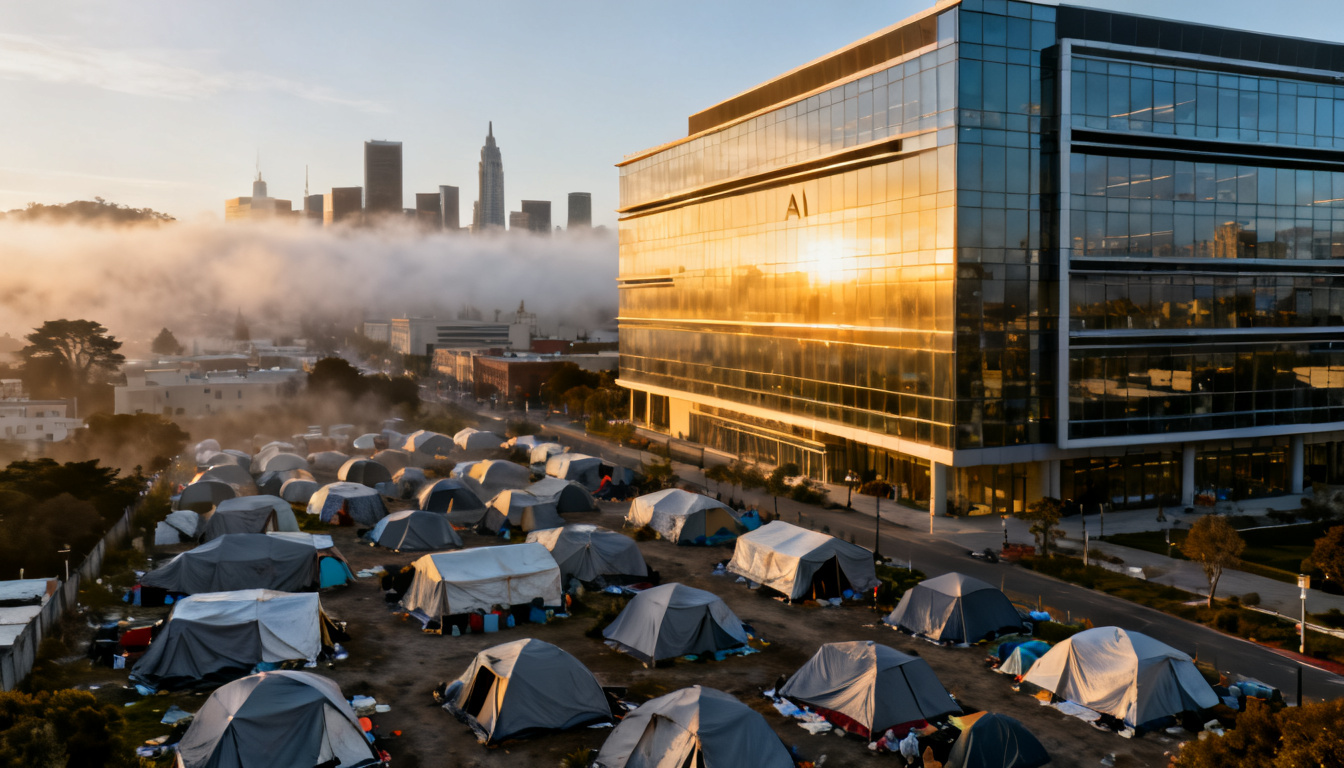
You’ll notice something odd if you go around SoMa on a Tuesday afternoon. On one block, programmers with laptop bags worth more than some people’s monthly rent may slide open the glass doors of a shiny office lobby with the brand of a recently financed AI business. A tent half a block distant. Then one more. People who live here no longer consider the disparity uncommon, which is perhaps the most significant indication of what Silicon Valley has subtly become.
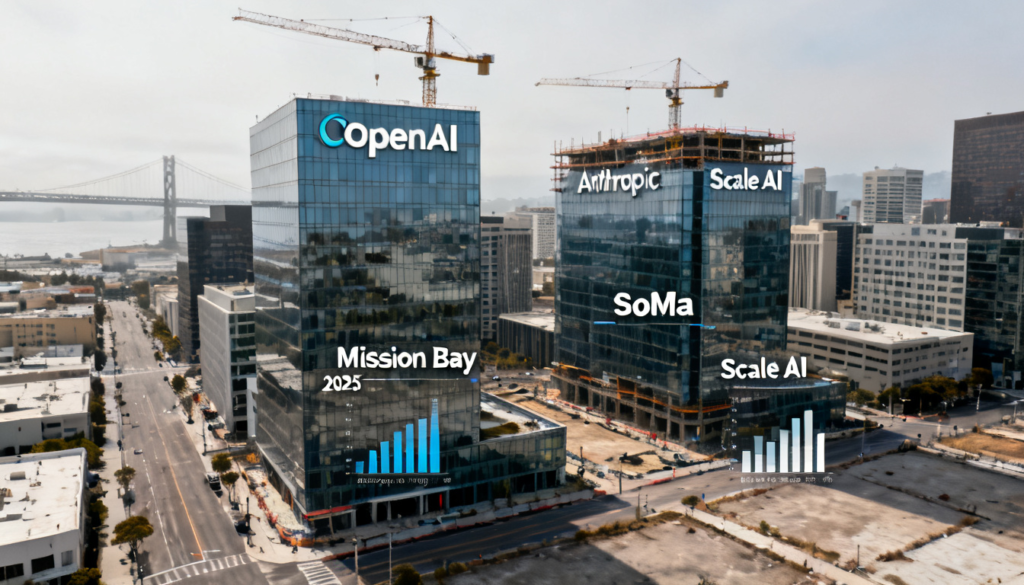
By any standards, the data emerging from San Francisco is astounding. According to PitchBook statistics, venture capital financing for AI startups in the area exceeded $29 billion in the first half of 2025 alone, more than twice that of the same period in 2022. Since late 2022, AI companies have rented more than 4.3 million square feet of office space around the city.
The largest agreement in the city since 2018 was reached when OpenAI secured a 500,000-square-foot lease at Uber’s former Mission Bay headquarters. Standing on a podium at the GPU Technology Conference, Jensen Huang proclaimed that San Francisco is returning with the assurance that comes with leading the world’s most significant semiconductor corporation. He was believed in some circles.
However, the boom is having effects that the optimists either failed to account for or neglected to discuss. In San Francisco, there are still around 7,000 homeless people living in tent encampments that are often practically within walking distance of AI campuses.
In contrast to the funding headlines, the city’s tech employment figures tell a more subdued story: as of late 2025, the number of tech jobs in the two-county area had largely remained unchanged since the beginning of the year, hovering at 190,000. Without creating the widespread job boom that earlier innovation cycles did, the AI wave is producing immense wealth and economic activity. The top economist for San Francisco, Ted Egan, stated it bluntly: there aren’t enough AI jobs to support a rebound just now.
Seldom do press releases reflect the rising dissatisfaction inside the sector. A new phenomenon is being reported by therapists in the Bay Area: a specific type of fear among the very professionals who are creating these systems. A psychologist in Menlo Park reported seeing her clients discuss “the end of the world” in ways she had never heard before. According to a therapist in San Francisco, almost 40% of his patients are employed in artificial intelligence.
These are not individuals who are concerned about losing their employment. Many of them are concerned about the results of their work. The anxiety is existential in a manner that is difficult to describe outside of the Bay Area bubble, but it exists, it is genuine, and it takes up a lot of money each week in therapy sessions.
It’s important to keep in mind that Silicon Valley has a long history of acting first and considering implications later. This pattern was continued in the social media era, as platforms designed to foster connections were later linked to loneliness, political extremism, and adolescent mental health crises.
A Tech Boom With Consequences Silicon Valley Didn’t Predict
| Category | Details |
|---|---|
| Topic | Silicon Valley AI boom and its unintended social, economic, and psychological consequences |
| Location | San Francisco Bay Area, California, USA |
| AI Venture Capital Funding (H1 2025) | Over $29 billion in San Francisco metro area (PitchBook) |
| AI Office Space Leased Since 2022 | 4.3 million+ square feet across San Francisco |
| Tech Layoffs in Bay Area (2025) | 35,000+ (Layoffs FYI) |
| Homelessness in San Francisco | 7,000+ individuals unhoused (latest city count) |
| Worker AI Job Anxiety | 52% of U.S. workers worried about AI’s impact on employment (Pew, 2025) |
| Key Companies | OpenAI, Anthropic, Nvidia, Scale AI, Perplexity, Databricks |
| Reference Sources | Pew Research Center – AI and the Future of Work · SF Examiner – AI Boom and Tech Jobs |
The same “disrupt first” mentality that gave rise to Facebook and Twitter is now driving the development of systems that, according to their own developers, have the potential to drastically alter the labour market in ways that are too complex to fully anticipate. According to a 2025 Pew study, 52% of American workers are concerned about how AI will affect their professions, and 32% think it will eventually lead to fewer jobs. These are not peripheral issues.
This cycle differs from the dot-com boom of the late 1990s in terms of capital concentration and pace. According to Crunchbase, Bay Area entrepreneurs raised $90 billion in venture capital in 2024 alone, accounting for 57% of total U.S. fundraising.
The companies that write the cheques, Sequoia, Andreessen Horowitz, and Lightspeed, are all gathered along Menlo Park’s Sand Hill Road, a few miles apart. Innovation is effectively produced by this type of focused decision-making, yet the effects of those decisions go far beyond the decision-makers.
The irony in all of this is difficult to ignore. The same businesses that promote AI’s potential to address humanity’s most pressing issues, such as illness, climate change, and transportation, are located in a city where thousands of people are homeless.
It would be unjust to confine a complicated housing and social policy failure to the doorstep of a single company, and that is not a straightforward cause-and-effect connection. However, there are serious concerns about what “progress” is really measuring and for whom the outcomes are being optimised when extraordinary wealth creation and obvious, ongoing poverty coexist in the same zip codes.
How this is resolved is yet unknown. The AI boom may eventually lead to widespread employment and an expansion of the tax base that benefits more people than just the wealthiest. Regulations may catch up and compel a more truthful assessment of how the technology affects the job market.
Alternatively, the cycle can follow the well-known pattern of exuberance, overstretching, and correction, leaving a new generation of Bay Area workers and residents to deal with the fallout. The future’s factories are in operation. It’s still really unclear who is creating the future and for whom.