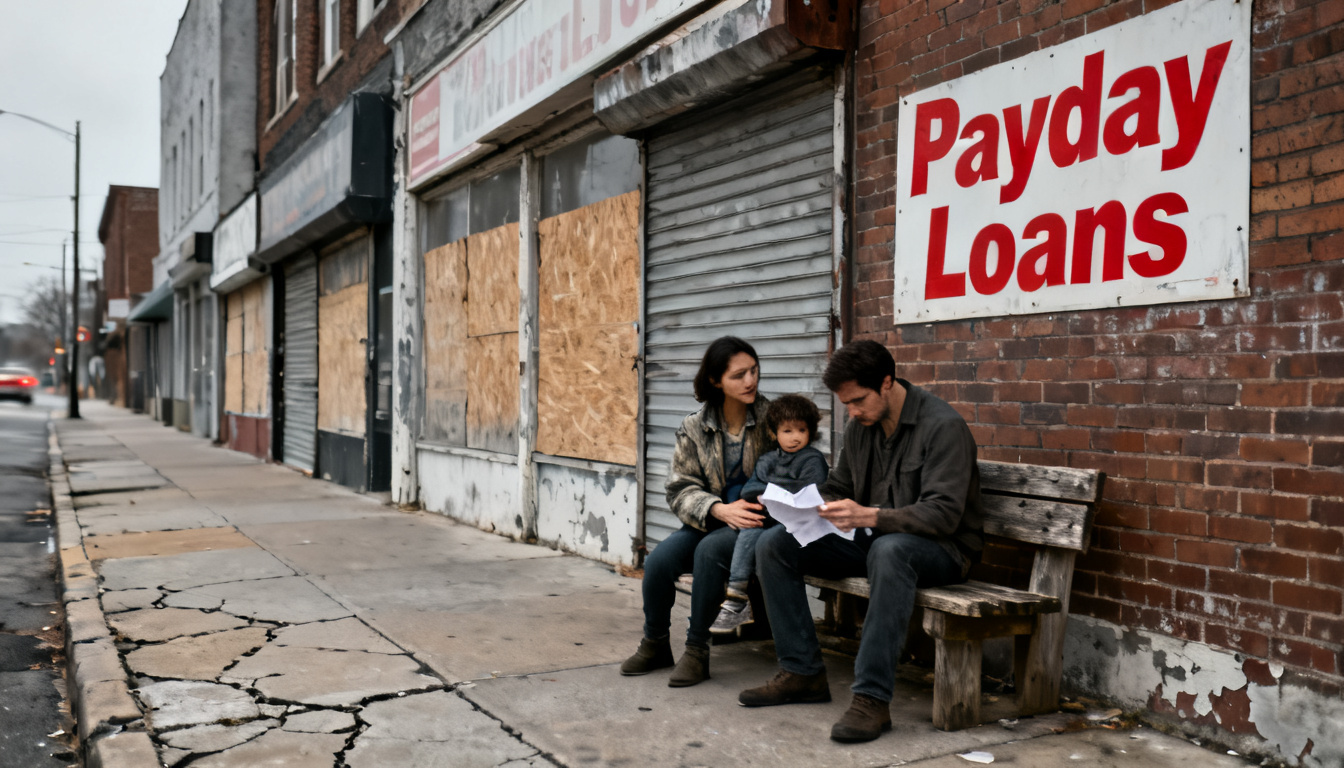
Every American recession is followed by a ritual. Washington starts to proclaim success as the data start to improve: jobs are added, GDP is gradually increasing, and the Dow has crossed a symbolic milestone. There are press conferences. There are charts on show.
Someone mentions the term “resilience.” However, something seems strange when you drive through specific areas of Ohio or stroll through a mid-sized city in the American South. The shops are still only partially occupied. The folks appear worn out. Whatever the recovery is, it’s not quite here yet.
This discrepancy between the evidence and people’s perceptions is not new. However, it continues to grow, and the nation remains shocked by it. It’s likely that America has developed a whole lexicon around economic health that was never intended to quantify the experience of ordinary people, which is why the confusion may extend beyond politics.
GDP gauges productivity rather than well-being. The millions of people who have given up looking for work are not included in unemployment statistics; only those who are actively seeking employment are. Our measurements reveal a portion of the narrative while subtly omitting the remainder.
While banks were being bailed out and homeowners were still losing their homes years later, a pivotal event in the aftermath of the 2008 financial crisis didn’t make many headlines: the official recovery was announced in June 2009. In a technical sense, the economy had “recovered.” Apparently, the criteria did not apply to families who had lost everything. Since then, the conflict between recovery as a statistical phenomenon and recovery as a human experience has persisted, becoming more apparent with each economic cycle.
There is a structural component to the issue. Approximately 58% of Americans own stock, and that ownership is largely concentrated at the top, making the U.S.’s long-standing practice of using the stock market as a stand-in for economic health all the more bizarre. The fortunes of those who were initially financially secure are most evident when the S&P 500 rises sharply following a slump. It’s difficult to ignore how frequently the “recovery is here” pronouncements align with Wall Street achievements rather than, say, household debt alleviation or median rent stability.
Key Information
| Category | Details |
|---|---|
| Topic | U.S. Economic Recovery Policy & Public Perception |
| Focus Area | Macroeconomic indicators vs. lived economic experience |
| Key Institutions | Federal Reserve, U.S. Bureau of Labor Statistics, Congressional Budget Office |
| Relevant Metrics | GDP growth, unemployment rate, consumer sentiment index, wage growth |
| Common Recovery Benchmarks | Stock market performance, job numbers, inflation rate |
| Reference Links | U.S. Bureau of Labor Statistics — Official Economic Data |
| Federal Reserve — Economic Research & Data |
Additionally, there is a strong perception in American policy circles that the primary indicator of recovery is job creation. When there are enough jobs, everything else falls into place. Until you consider the calibre of those occupations, the hypothesis seems plausible enough.
Millions of jobs were added to the labour market following the 2020 recession, many of which were in industries with hourly wages of $14, no benefits, and erratic schedules. People who were employed were counted. They weren’t necessarily improving. The disparity is significant and difficult for official data to adequately convey regarding the urgency of policy.
Observing the construction of recovery narratives gives the impression that the nation has established an institutional optimism that is at odds with critical evaluation. Since it appears politically dangerous to acknowledge that a recovery is incomplete, that is, that some people are benefiting from it while others are not, it seldom occurs with any clarity. As a result, when the public learns that recovery has occurred, they look at their own lives and feel either misled or perplexed. In a way, both responses make sense.
The fact that there are instruments to gauge a more thorough recovery is disheartening. rise in wages by income quintile. ratios of housing costs to income. rates of food insecurity. levels of medical debt. These are tracked, publicised, and frequently overlooked in the summary narrative; they are not esoteric academic data pieces.
This has been argued for decades by some economists, especially in more unconventional circles, who contend that a rebound that doesn’t reach the bottom half of the income distribution is more a transfer of momentum to those who were already moving than a true recovery.
Whether there is political will to alter the definition and communication of recovery remains up for debate. Although there have been certain gestures, such as the Biden administration’s attempt to highlight “bottom-up” economic rhetoric, the underlying measuring methods and the media practices around them have not changed quickly. Both the figures and the individuals who read them are essentially unchanged.
Perhaps it’s not the rehabilitation per se that America consistently fails at, but rather the narrative it presents about recovery. choose to measure what is simple instead of what is important. celebrating a return to pre-crisis circumstances in a nation where many people were already falling behind. The healing process begins. The gap widens. Additionally, a shop in a mid-sized city remains vacant for a little while longer, waiting for something that the charts indicate has already arrived.