The way the light filters over Spanish moss and rests on quiet water before the tourist boats begin to move is a unique aspect of the early morning light along Florida’s Nature Coast. That stillness has always existed in Homosassa. It’s the type of location where manatees emerge from the springs, and locals continue to argue over whether visitors should be allowed to learn about it. Therefore, it’s important to pay attention to what’s happening on a portion of Citrus County’s forested area right now.
A rezoning proposal for Stillwater Estates was overwhelmingly approved by county commissioners on April 15, 2026, removing the last regulatory obstacle to a major remodeling of what was already a sizable RV resort complex. It was a big adjustment.
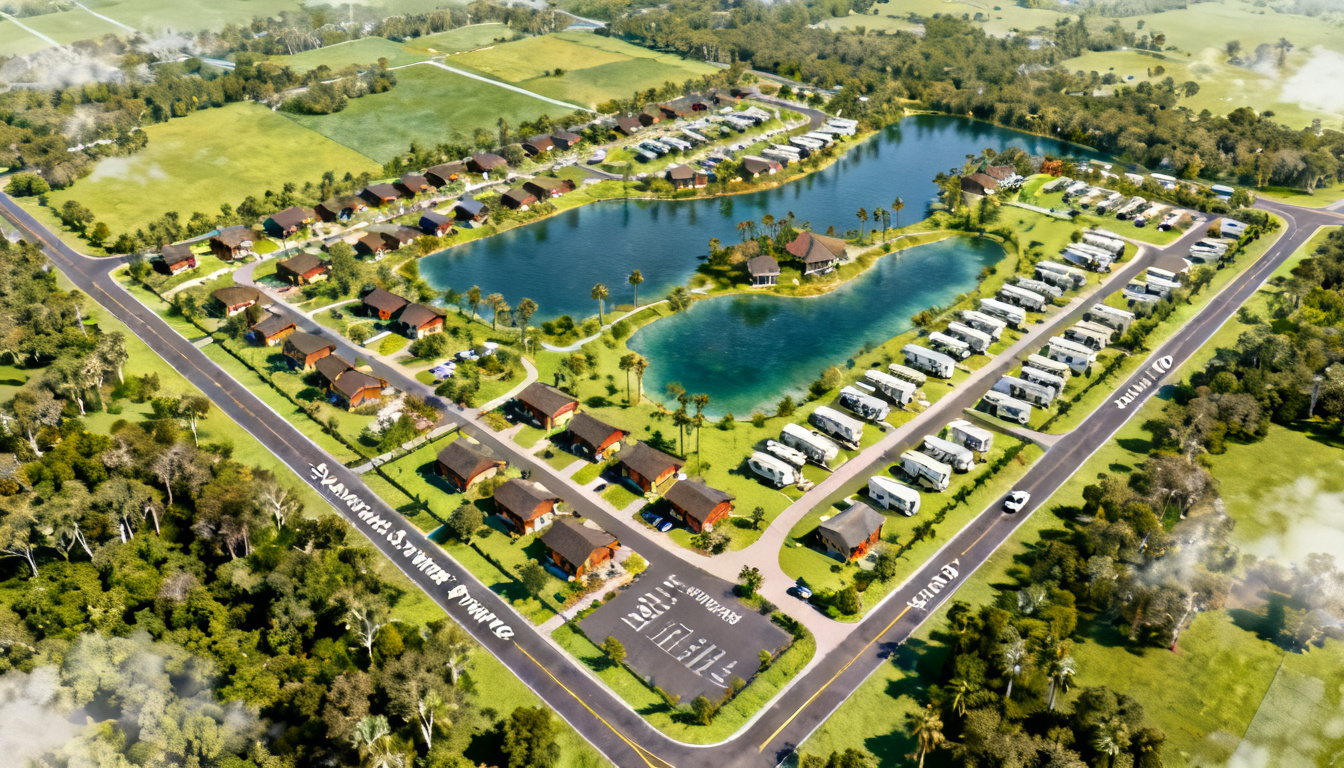
Instead of the 55 cottages initially intended, Phase 3 of the project, which would occupy approximately 39.6 acres of the larger, approximately 168-acre property, will support 110 RV spaces. That essentially doubles a single section’s capacity while completely changing the development’s character. Depending on who you ask, that might be a sign of progress or a warning.
The establishment of the Homosassa RV park wasn’t a smooth start. A separate developer attempted to push through a 196-space RV park on a 29.6-acre property in the same town years before Stillwater became the enterprise it is today, but Citrus County commissioners rejected it 4-1.
That decision was influenced by environmental and community concerns, as well as the sheer volume of proposals. This past ruling serves as a reminder that this terrain has already been disputed and lingers somewhat in the background of the current discussion. It is noteworthy that the present plan passed by a unanimous vote, which raises the question of what was altered or what covert concessions were made during the process.
Stillwater Preserve focuses a lot of its marketing on luxury. According to the resort’s own description, it is situated on more than 176 peaceful acres, and its creators have embraced the concept of an RV experience that seems more like a well-kept outdoor living than camping.
The resort seems to be targeting a certain group of people: the weekend visitor who wants full hookups, concrete pads, and broadband internet without compromising the appearance of being in a natural setting, or the retired couple in a Class A motorcoach. Developers appear to think Homosassa is ready for this formula, which has succeeded elsewhere in Florida.
Important Information: Homosassa RV Resort Development
| Category | Details |
|---|---|
| Key Project | Stillwater Preserve RV Resort / Stillwater Estates |
| Location | Homosassa, Citrus County, Florida |
| Total Acreage | Approximately 168–176 acres |
| Phase 3 Change | 55 planned cabins converted to 110 RV sites across 39.6 acres |
| Approval Date | April 15, 2026 (unanimous county commissioner vote) |
| Prior Review | Planning & Development Commission voted 5–2 in February 2026 to recommend |
| Notable Operator | Sun Retreats Homosassa River (Sun Outdoors network) |
| Sun Retreats Address | 10200 West Fishbowl Dr., Homosassa Springs, FL 34448 |
| Contact | (352) 628-2928 |
| Nearby Attraction | Homosassa Springs Wildlife State Park (within 1 mile) |
| Reference Links | Citrus County Chronicle – RV Resort Clears Final Hurdle / Sun Retreats Homosassa River |
A helpful parallel is provided by Sun Retreats Homosassa River, a different but similar business located next to Homosassa Springs Wildlife State Park. With more than 200 RV sites across different grades, such as premium brick-bordered sites, elite concrete pull-throughs, and regular gravel pads, the RV resort industry has become tiered and divided.
These aren’t the campsites of your dad. RV stays, which start at $58 per night for basic connections and go up significantly for premium concrete pads with awnings and DirecTV, indicate that finding the perfect balance of amenities can generate substantial cash. The company plan is clear. Simply said, it’s more advanced than it appears on the exterior.
However, it’s difficult to ignore that converting planned cabin units into RV sites doubles occupancy potential and may even reduce the fixed construction load. Cabins need housekeeping, maintenance personnel, utilities that run to permanent structures, and foundations.
Once constructed, RV sites just require connections and concrete or gravel. It’s unclear from the public record if commissioners considered that economic reasoning when making their judgment. Even if they didn’t win out in the end, the Planning and Development Commission’s previous 5-2 recommendation indicates that there were some concerns.
For many years, Homosassa has been the more sedate relative of Crystal River, which is located just up the coast and receives many more tourists. The springs system, manatee habitat, and other natural attractions that have made this section of Florida’s west coast subtly famous among outdoor lovers are shared by both towns. Even if no single building significantly alters the area’s carrying capacity, the growth of RV park infrastructure does. It’s conceivable that locals and environmentalists are more interested in the overall impact than any one project.
Stillwater Preserve proceeds for the time being. The rezoning has been authorized, the commissioners have spoken, and the 55 cabins will be replaced by 110 RV spots. It’s still unclear whether Homosassa’s springs, animal corridors, and unique stillness will make it the ideal choice in 5 or 10 years.
Certain locations gently absorb development. Some people don’t. With its manatees, moss, and long-standing refusal to become simply another Florida vacation spot, Homosassa seems deserving of the benefit of the doubt. And maybe a closer look as well.