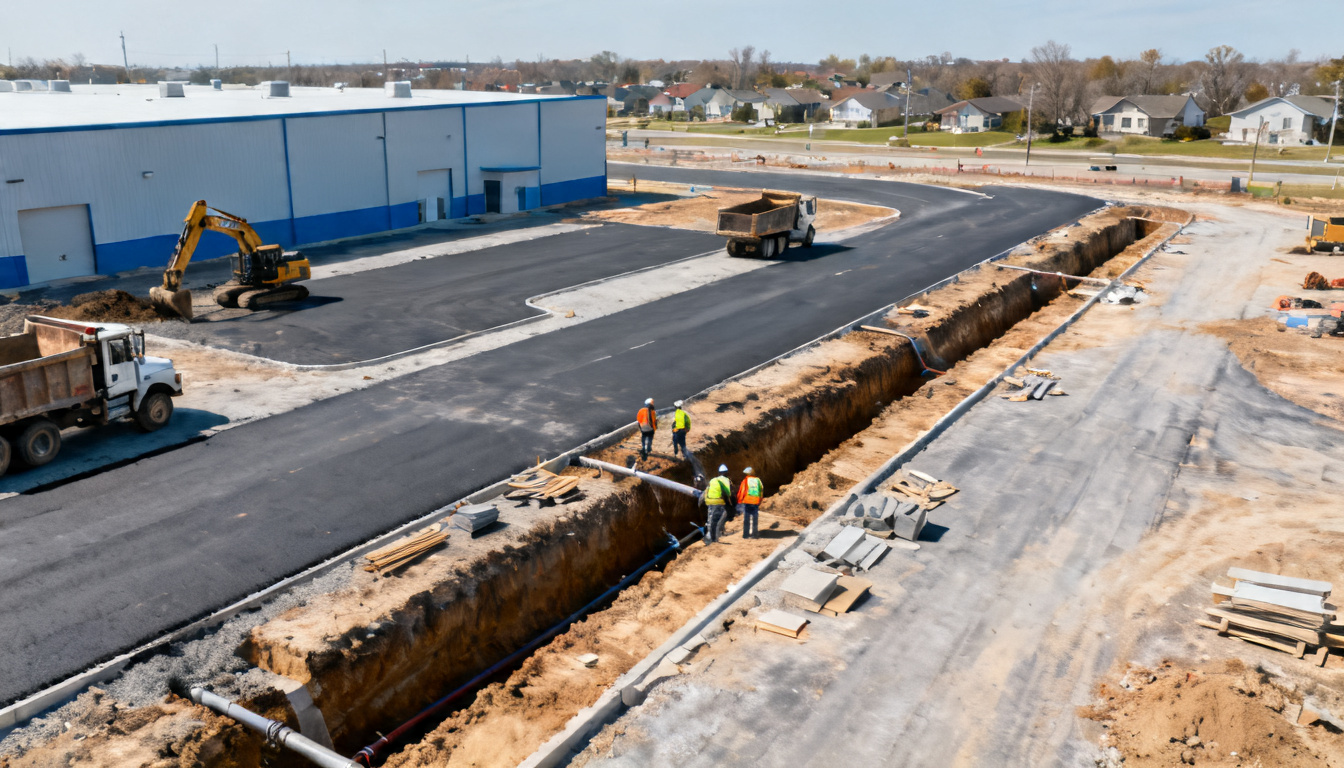
On a Tuesday morning, you might believe you’ve made a mistake as you drive into Huntsville, Alabama. The city is not the type of town that appears on investment banking presentations; it stands quietly and modestly beneath a pale Southern sky. It’s more difficult to overlook a Toyota manufacturing complex that is growing at a rate that would make some coastal tech campuses blush if you stroll beyond the construction barriers on the town’s eastern boundary. Cranes. beams of steel. hundreds of employees wearing highly visible vests. A multinational automaker determined that this was the place where the future would be constructed, somewhere between the kudzu and the catfish eateries.
Most individuals are unaware of how widespread it is. Ohio’s Columbus. South Carolina’s Greenville. Iowa’s Des Moines. Cities that Wall Street and foreign finance disregarded for decades are now subtly emerging as some of the nation’s busiest investment hubs. The causes are more complex than a headline can convey, but they are not strange.
Start with the price. For anyone attempting to construct something tangible, such as a factory, a logistics centre, or a semiconductor fabrication plant, commercial real estate in San Francisco or Manhattan has become almost absurdly costly. The land in Huntsville is much less expensive. Tulsa does as well. Boise’s does, too. Moving away from the coasts significantly alters the math for a German auto parts supplier or a South Korean chipmaker looking to set up facilities in the United States. This type of change might never be motivated only by cost. Cost, however, is only the first point of contention.
Passed in 2022, the CHIPS Act and the Inflation Reduction Act altered the equation in ways that continue to have an impact. Companies developing in the US now have access to billions of dollars in federal incentives, but the best offers frequently go to states and local governments that are prepared to stack their own incentives on top of Washington’s.
For years, communities like Greenville and Columbus had been discreetly preparing their pitch decks, building connections with economic development offices, transforming community colleges into pipelines for technical training, and arguing that their workforces were dependable in ways that tight urban labour markets frequently weren’t. These cities were prepared when the government funds arrived.
Quick facts
Global Investment in America’s Secondary Cities
| Trend category | Foreign Direct Investment (FDI) into non-gateway U.S. metros |
| Key cities involved | Columbus (OH), Tulsa (OK), Huntsville (AL), Greenville (SC), Boise (ID), Des Moines (IA) |
| Major investing regions | Germany, Japan, South Korea, Canada, the United Kingdom, and Taiwan |
| Primary sectors | Advanced manufacturing, semiconductors, EV supply chain, logistics, life sciences |
| Key policy drivers | CHIPS Act (2022), Inflation Reduction Act (2022), Infrastructure Investment and Jobs Act |
| FDI into the U.S. (2023) | Approx. $311 billion — with a growing share landing outside NYC, LA, and SF |
| Workforce advantage | Lower labour costs, lower turnover, proximity to technical colleges and apprenticeship pipelines |
| Reference sources | SelectUSA — U.S. Dept. of Commerce Brookings Institution — Metropolitan Policy Program |
| Trend trajectory | Accelerating — new announcements reported monthly through 2024–2025 |

This labour tale merits greater attention than it typically receives. Turnover is a topic that businesses entering secondary marketplaces frequently bring up. There is fierce rivalry for skilled workers in large metropolitan regions. Employees switch jobs. Wages are spiralling. It’s still conceivable to develop a steady, devoted staff in Columbus or Des Moines, people who grew up close by and aren’t likely to quit for a rival across town because there isn’t one. It’s still uncertain if that stability will hold when additional businesses come in. However, it’s currently a strong selling feature, and international businesses appear to accept it.
Decades before anybody else, Japanese manufacturers realised this. In 1982, Honda decided to build its first factory in the United States in Marysville, Ohio. At the time, this choice seemed strange, but fifteen years later, it seemed prescient. Going inland, where property was inexpensive, unions were less established, and local governments were genuinely interested, proved a wise decision. The scale and pace have changed. It’s not just one or two businesses placing a wager. Within a few years of one another, scores of different industries have reached the same conclusion.
It’s difficult to ignore the fact that geopolitics has a greater influence on this energy than economics. The epidemic revealed how fragile global supply networks had become, with too much production concentrated in too few locations and too far from final consumers. Reshoring evolved beyond a catchphrase.
Businesses in South Korea, Japan, and Germany began to seriously reconsider where they wanted to locate their production. If the response was “inside the United States,” the following query was precisely where. There was no way to go to New York. It wasn’t intended for Los Angeles. Suddenly, the country’s interior was.
The texture of what’s truly changing on the ground is something that none of this fully conveys. In certain areas of Greenville, the economic legacy of deindustrialisation remains vivid, with old textile mill signs still hanging over repurposed buildings. Although it didn’t completely erase that past, BMW’s entry into manufacturing in the 1990s, which now produces over 400,000 cars annually at the neighbouring Spartanburg plant, began to change perceptions of what was feasible in the area. These businesses are entering communities that have previously learned, although imperfectly and with some scars, how to adapt to such change.
Whether federal incentives endure political changes, whether workforce pipelines can truly expand, and whether multinational corporations remain committed when the next upheaval strikes are among the unanswered questions that will likely determine whether this boom is cyclical or sustainable. Investors appear to think the trend will continue. It appears that the cranes in Huntsville concur. And it could be sufficient for the time being for cities that waited a long time to be acknowledged.